Region
India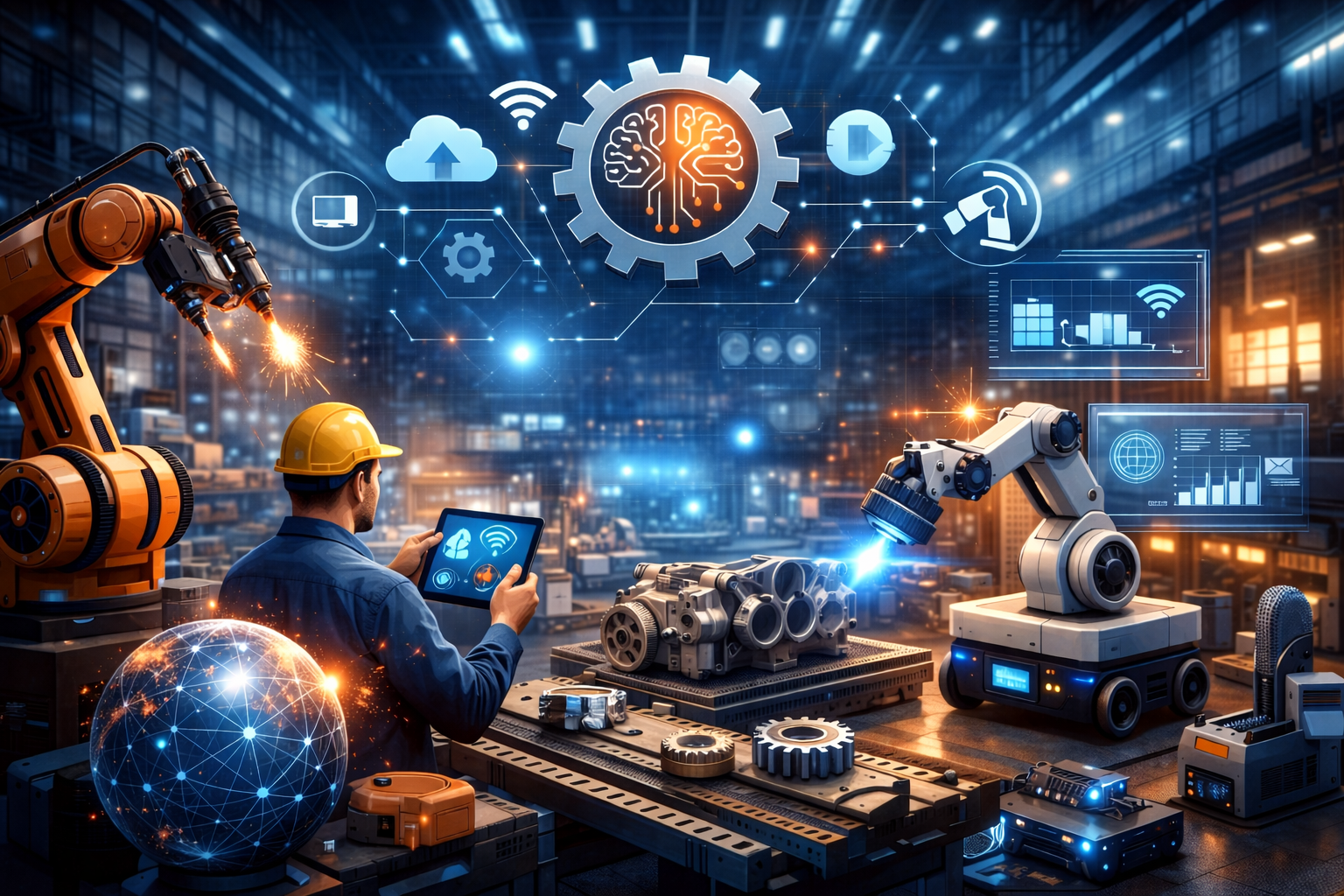
The manufacturing industry has evolved tremendously with the advent of Industry 4.0 technologies, streamlining production and operations. The rise in digital manufacturing is driven by integrating smart technologies, predictive analysis, and automation, enabling cost optimisation and improved efficiency. AI is playing a dominant role in expanding the arms of Industry 4.0 by helping with new ways to harness data, enable innovation, and improve overall decision-making.
The manufacturing world is witnessing a seismic shift with Industry 4.0 moving beyond simple automation. The combination of innovative technologies helps in turning complex industrial challenges into sustainable solutions. This blog explores emerging technologies, challenges, and digital transformation shaping the manufacturing world.
What is Industry 4.0 in manufacturing?
It refers to smart manufacturing and digital transformation, enabling companies to enhance productivity and agility. Integration of new technologies, including IoT, AI, cloud computing, etc., into production facilities streamline operations. Industry 4.0 manufacturing embeds technology to create smart factories equipped with advanced software, robotics, automation, and sensors. Collectively, these collect and analyse data while ensuring process optimisation and predictive maintenance.
Key Trends in Industry 4.0 Manufacturing
AI and Machine Learning: The convergence of Agentic and Generative AI has revolutionised businesses, moving beyond simple data analysis into autonomous execution. While traditional machine learning powers predictive maintenance to slash downtime, Agentic AI now acts as an intelligent operator. These agents autonomously route production flows, manage real-time inventory levels, and optimise complex manufacturing processes, transforming factories into self-correcting, “thinking” ecosystems.
Automation in manufacturing: One of the most powerful tools that optimises both processes and cost by integrating machine-driven automated systems. This increases operational efficiency as well as reduces labour costs. Robots are predominantly being used as part of industrial automation, ensuring precision and safety. Robotics arms, for example, are used in assembling vehicles, while they are also used in food processing plants in automated sorting, packaging, and labelling.
Data-driven manufacturing through IoT: Powered by innovative tools, software, and AI, leveraging data-driven manufacturing helps with real-time data collection, analytics, and optimising production processes. With sensors, IoT, and cloud computing, manufacturers can make informed decisions across operations. Sensors embedded in equipment, for example, offer real-time monitoring and continuous feedback. Additionally, sensors can monitor conditions like temperature, vibration, and pressure, along with streamlining energy management.
Digital Twins – Industry 4.0 technologies like digital twins are commonly integrated across manufacturing for their ability to simulate real-world conditions. These are virtual replicas of physical assets that test scenarios, check for performance gaps, and suggest the scope of improvement. Through simulation of the entire production line or machines, manufacturers can test or incorporate changes virtually before their implementation in the physical environment.
Cloud Computing – Digital transformation in the manufacturing industry is marked by integrating digital technologies, with cloud computing marking a critical integration. Smart manufacturing demands connectivity and storage of secured data online for easy access. With cloud, large amounts of data can be stored, analyzed, and processed efficiently with its global access.
Cybersecurity – Robust security measures across manufacturing are critical to protect sensitive data and prevent any kind of breach or operational disruption. Advanced cybersecurity solutions help in safeguarding data and industrial control solutions, and help in maintaining operational confidentiality for clients.
Custom manufacturing – Smart factories have technologically advanced tools that help in the custom development of products that meet specific customer needs. Integration of advanced simulation software, 3D printing, and new technologies helps manufacturers create small batches of products in a cost-effective manner.
What are the key Industry 4.0 challenges?
Despite the integration of advanced technology, manufacturing industries face numerous Industry 4.0 challenges.
- Cybersecurity Risks – With factories connected through IoT, cloud, and edge systems, there is an increase in attack surface. Sophisticated AI-powered attack further compromises sensitive data and impacts business continuity. Protecting operational technology (OT) alongside IT systems is complex and critical.
- Updating Legacy Systems – Many manufacturers operate on outdated infrastructure. Integrating modern digital tools with legacy machinery and ERP systems is costly and technically challenging, also demanding a workforce that is skilled to run updated systems.
- Higher implementation costs – Innovative technology integration, deployment, and use come with a cost. Deploying smart sensors, automation, AI platforms, and advanced analytics requires significant upfront investment, with ROI often unclear in the short term.
- Analysis of large data set – Industry 4.0 means reliance on digitalization often requiring analysis of a massive volume of data. Ensuring data quality, standardisation, seamless interoperability between systems, and actionable insights remains a major hurdle.
- Workforce Readiness – There is a shortage of skilled professionals who understand AI, robotics, cybersecurity, data analytics, and smart manufacturing systems. Upskilling the existing workforce is equally challenging.
In response to these challenges, the manufacturing sector is adopting targeted Industry 4.0 solutions.
Industry 4.0 solutions have helped in digital transformation in the manufacturing industry by connecting people, operations, and data to advanced technology. Be it IoT, AI, big data analytics, cloud or cybersecurity, it offers real-time visibility across operations, predicts equipment, and automates processes. Digital twin is perfect for creating a simulation or replica of processes, enabling better accuracy and the creation of responsive production systems.
Beyond the factory floor, Industry 4.0 solutions extend to supply chain optimisation, collaborative design, and sustainability goals. Real-time data sharing and AI-powered analytics streamline logistics, inventory management, and demand forecasting, helping businesses react swiftly to market shifts and reduce lead times. Collaborative platforms and cloud-based systems break down information silos, enabling cross-functional teams to innovate faster and deliver tailored products to customers. At the same time, advanced connectivity is coupled with stronger cybersecurity frameworks to protect digital ecosystems as they scale.
Industry 4.0 is redefining manufacturing by blending intelligence, automation, and connectivity into a unified digital ecosystem. As manufacturers overcome cost, skill, and cybersecurity challenges, those who strategically adopt smart technologies will Unlock Next levels of efficiency, resilience, innovation, and sustainable growth in an increasingly competitive global landscape.
Integrate the best of Industry 4.0 practices across manufacturing. To learn more or discuss tailored solutions, get in touch with us.