Enterprise Storage FAQs | SAN vs NAS, NVMe & Dell PowerStore | Redington
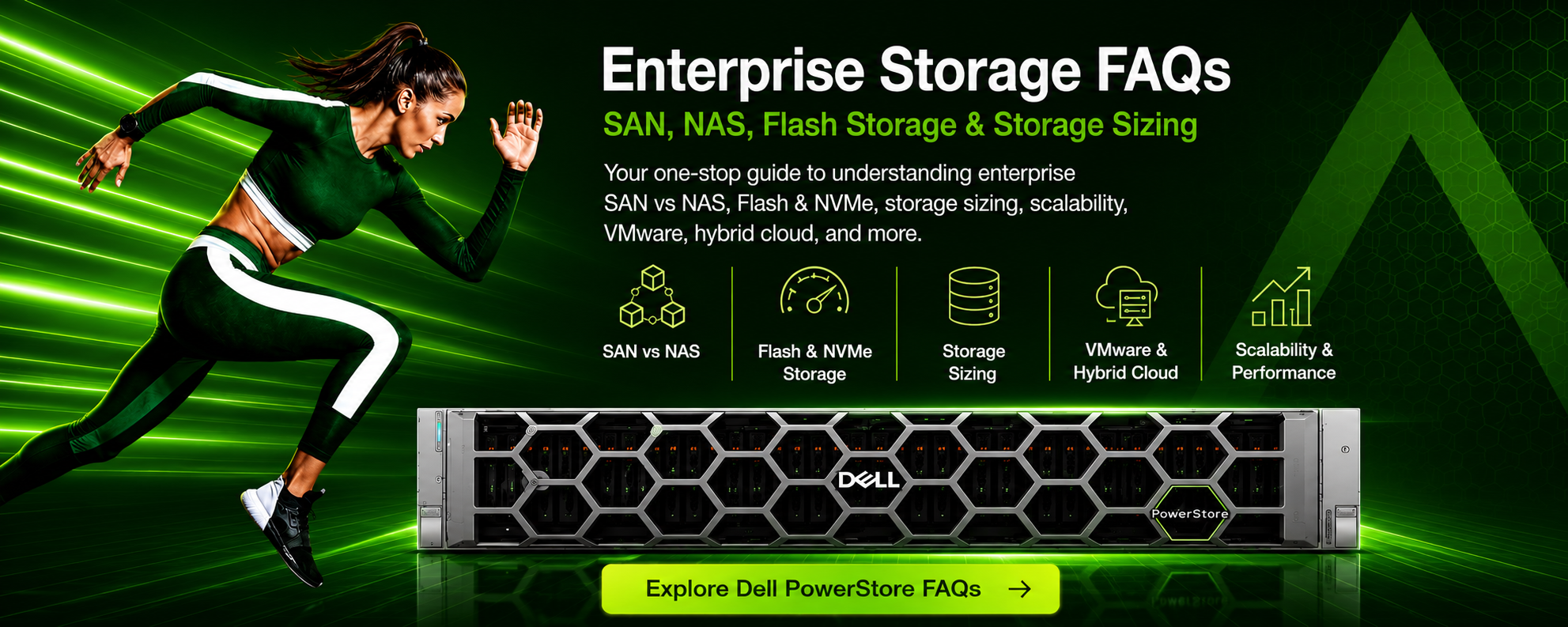
Dell PowerStore enterprise storage FAQs — SAN vs NAS, NVMe, VMware banner

Enterprise Storage Knowledge Hub

UnlockNext™: Enterprise Storage FAQs Explained — SAN vs NAS, NVMe, VMware & Dell PowerStore

Understand SAN, NAS, flash storage, NVMe architecture, storage sizing, virtualization infrastructure, hybrid cloud environments, and modern enterprise storage technologies with this comprehensive enterprise storage FAQ guide.

Executive Summary

As organizations expand virtualization environments, AI initiatives, analytics platforms, and hybrid cloud operations, enterprise storage has become a critical component of business success.

This FAQ guide answers common questions about SAN and NAS storage, flash and NVMe technologies, storage sizing, VMware environments, scalability planning, and modern storage strategies. It also explores how Dell PowerStore helps organizations modernize infrastructure and prepare for future growth.

What You’ll Learn

Explore Modern Enterprise Storage Concepts

Enterprise storage decisions increasingly influence application performance, operational efficiency, business continuity, and readiness for AI-driven innovation.

This guide helps IT leaders, infrastructure architects, and business decision-makers understand the technologies and strategies shaping modern storage environments.

SAN vs NAS Storage

Understand the differences between block storage and file-based storage architectures used in enterprise environments.
Flash & NVMe Storage

Learn how all-flash and NVMe-based infrastructure improves performance, latency, and workload efficiency.

Storage Sizing

Explore how organizations estimate storage requirements for virtualization, analytics, and growing enterprise workloads.

VMware & Hybrid Cloud

Understand storage considerations for VMware environments, hybrid cloud infrastructure, and workload mobility.

Performance & Scalability

Discover how modern enterprise storage platforms support scalability, operational efficiency, and business continuity.

Why Enterprise Storage Matters Beyond IT

For business leaders, storage infrastructure directly impacts application responsiveness, employee productivity, customer experience, analytics performance, operational efficiency, and business continuity.

As organizations become more data-driven, storage modernization plays an increasingly important role in supporting innovation, scalability, and long-term business growth.

FAQ

SAN vs NAS Storage FAQs

Understanding the difference between SAN and NAS storage helps organizations align infrastructure investments with workload requirements, performance expectations, collaboration needs, and future scalability goals.

SAN (Storage Area Network) is a high-performance storage architecture that provides block-level storage access to servers and enterprise applications. SAN environments are commonly used for virtualization, databases, and mission-critical workloads that require low latency and fast data access. Platforms like Dell PowerStore are designed to support modern SAN environments with high-speed NVMe-based performance and scalable infrastructure capabilities.

NAS (Network Attached Storage) is a file-based storage solution that allows multiple users and devices to access shared files over a network. NAS storage is commonly used for file sharing, collaboration, backups, and centralized data access across enterprise environments.

The primary difference between SAN and NAS is how data is accessed. SAN provides block-level storage typically used for high-performance enterprise applications and virtualization, while NAS provides file-level storage designed for shared access and collaboration. Modern platforms like Dell PowerStore can support both enterprise SAN workloads and flexible unified storage environments.

SAN storage is generally preferred for virtualization environments because it delivers lower latency, higher performance, and better workload scalability for virtual machines. Dell PowerStore is particularly well-suited for VMware and virtualization environments due to its NVMe-first architecture, intelligent automation, and optimized performance capabilities.

In most enterprise environments, SAN storage is typically faster than NAS because it is designed for high-performance block-level data access with lower latency. SAN architectures are commonly used for virtualization, databases, analytics, and modern enterprise applications that require consistent high-speed performance.

Organizations commonly use NAS storage for file sharing, collaboration, backup environments, centralized file access, and workloads that require shared network storage across teams or departments.

The right storage architecture depends on workload requirements. SAN environments are often preferred for virtualization, AI workloads, analytics, and performance-intensive enterprise applications, while NAS environments are widely used for collaboration and file-sharing workloads. Modern enterprise platforms like Dell PowerStore help organizations support evolving workload demands with scalable, high-performance storage infrastructure designed for both operational flexibility and future growth.

FAQ

Flash Storage & NVMe FAQs

Modern workloads require storage platforms capable of delivering low latency, high throughput, and predictable performance. Flash and NVMe technologies have become foundational components of enterprise infrastructure modernization strategies.

Flash storage is a high-performance storage technology that uses solid-state memory instead of traditional spinning disks. It delivers faster data access, lower latency, and improved application responsiveness, making it ideal for virtualization, analytics, AI workloads, and modern enterprise applications. Platforms like Dell PowerStore use modern flash-based architecture to support demanding enterprise environments.

NVMe (Non-Volatile Memory Express) is a modern storage protocol designed specifically for high-speed flash storage devices. NVMe improves communication between storage and applications, helping reduce latency and increase throughput for enterprise workloads. Dell PowerStore uses an NVMe-first architecture to deliver faster and more efficient workload performance.

Flash storage is significantly faster than traditional HDDs because it does not rely on moving mechanical components. This allows applications, virtual machines, databases, and analytics workloads to access data more quickly with lower latency and better overall responsiveness.

NVMe-based infrastructure helps enterprises improve workload performance, reduce latency, support higher throughput, and optimize modern applications such as virtualization, AI, analytics, and real-time processing. Dell PowerStore’s NVMe-first design helps organizations support growing enterprise performance demands more efficiently.

Enterprises are increasingly adopting all-flash storage to support virtualization growth, hybrid cloud strategies, AI workloads, and modern applications that require faster and more consistent performance. All-flash platforms also help simplify operations, improve scalability, and reduce infrastructure bottlenecks.

Yes. Flash storage is commonly preferred for VMware environments because it improves VM responsiveness, reduces latency, supports higher VM density, and delivers more consistent application performance. Dell PowerStore is particularly well-suited for VMware infrastructure due to its optimized virtualization capabilities and intelligent workload management.

NVMe improves enterprise application performance by enabling faster data access, lower latency, and higher throughput across storage environments. This helps organizations improve virtualization performance, accelerate analytics workloads, support AI applications, and maintain responsiveness for business-critical operations.

FAQ

Enterprise Storage Sizing FAQs

Choosing the right storage strategy requires balancing workload performance, scalability requirements, virtualization growth, AI readiness, operational simplicity, and long-term business objectives.

Organizations increasingly evaluate storage investments based on their ability to support future innovation while maintaining efficiency and operational flexibility.

Organizations typically calculate storage requirements based on workload type, application performance needs, virtualization environments, data growth expectations, backup requirements, and future scalability plans. Modern platforms like Dell PowerStore help businesses scale infrastructure more efficiently as storage demands evolve over time.

The amount of storage required for VMware environments depends on factors such as VM density, workload performance, application types, backup policies, and future growth plans. Enterprise virtualization environments often require high-performance, low-latency storage infrastructure capable of supporting multiple workloads simultaneously.

Several factors influence enterprise storage sizing, including virtualization workloads, application performance requirements, analytics processing, AI initiatives, backup and recovery policies, user growth, and data retention strategies. Organizations also consider scalability and operational flexibility when planning storage infrastructure.

Businesses typically plan for future storage growth by evaluating projected workload expansion, virtualization scaling, hybrid cloud adoption, analytics requirements, and long-term infrastructure modernization goals. Flexible platforms such as Dell PowerStore help organizations scale infrastructure without significantly increasing operational complexity.

Storage overprovisioning refers to allocating more storage capacity or performance resources than currently required to accommodate future growth, workload spikes, and business continuity requirements. This helps organizations maintain performance consistency as infrastructure demands increase.

AI and analytics workloads often require significantly higher storage performance and scalability compared to traditional business applications. Factors such as real-time processing, large datasets, GPU-intensive operations, and high-throughput requirements influence storage capacity and performance planning.

Scalability is critical because enterprise workloads, virtualization environments, analytics platforms, and data volumes continue to grow over time. Scalable infrastructure allows organizations to expand storage capacity and performance efficiently without disrupting operations or increasing management complexity.

FAQ

Modern Enterprise Storage Infrastructure FAQs

Understand how modern storage platforms support hybrid cloud environments, virtualization, AI workloads, business continuity, and operational simplicity.

Hybrid cloud storage combines on-premises storage infrastructure with cloud-based environments, allowing organizations to move workloads, applications, and data more flexibly across environments. Modern platforms like Dell PowerStore help businesses support hybrid cloud strategies with scalable, cloud-connected infrastructure designed for operational flexibility and workload mobility.

AI workloads typically require high-performance, low-latency storage capable of handling large datasets, real-time processing, analytics pipelines, and GPU-intensive operations. Modern NVMe-based all-flash platforms such as Dell PowerStore are well-suited for AI and analytics environments because they provide faster data access, scalable performance, and efficient workload handling.

Scalable enterprise storage refers to infrastructure that can expand capacity and performance efficiently as business workloads and data requirements grow. Modern scalable platforms help organizations support virtualization, analytics, hybrid cloud environments, and future infrastructure demands without significantly increasing operational complexity.

Low latency helps enterprise applications access and process data more quickly, improving responsiveness, user experience, virtualization performance, analytics processing, and overall operational efficiency. This is especially important for AI workloads, real-time applications, and business-critical enterprise environments.

Storage directly affects how quickly applications can read, process, and access data. High-performance storage infrastructure improves application responsiveness, reduces bottlenecks, supports virtualization efficiency, and enhances workload consistency across enterprise environments.

Enterprise storage virtualization allows organizations to pool and manage storage resources more efficiently across infrastructure environments. This helps improve scalability, simplify management, optimize workload distribution, and support modern virtualization strategies.

Businesses modernize storage infrastructure by adopting scalable, high-performance platforms that support virtualization, hybrid cloud environments, AI-driven workloads, automation, and operational simplicity. Organizations are increasingly choosing solutions like Dell PowerStore to improve performance, simplify storage management, and prepare infrastructure for future business growth.

FAQ

Dell PowerStore FAQs

Explore how Dell PowerStore supports virtualization, hybrid cloud strategies, AI-driven workloads, and modern enterprise infrastructure requirements.

Dell PowerStore is a modern all-flash enterprise storage platform designed to support virtualization, hybrid cloud environments, AI-driven workloads, and modern business applications. It combines high-performance infrastructure, intelligent automation, and flexible scalability to help organizations modernize enterprise storage operations.

Yes. Dell PowerStore is built on an NVMe-first architecture designed to deliver lower latency, faster data access, and improved workload performance for virtualization, analytics, AI, and business-critical enterprise applications.

Yes. Dell PowerStore is highly optimized for VMware environments and supports virtualization workloads with strong VMware integration, intelligent automation, lower latency performance, and scalable infrastructure capabilities. It is well-suited for organizations managing growing virtualized environments.

Yes. Dell PowerStore is designed to support hybrid cloud strategies by enabling workload flexibility, scalable infrastructure, and seamless integration across modern enterprise environments. It helps organizations support cloud-connected operations while maintaining performance and operational consistency.

Yes. Dell PowerStore is built to support modern AI and analytics workloads that require high throughput, low latency, scalable performance, and efficient data processing. Its modern architecture helps organizations manage demanding data-intensive applications more effectively.

Dell PowerStore simplifies storage management through intelligent automation, centralized management capabilities, streamlined provisioning, and operational efficiency features designed to reduce infrastructure complexity and simplify day-to-day storage administration.

Organizations are increasingly choosing Dell PowerStore because it offers a modern, scalable, and future-ready storage architecture capable of supporting virtualization, AI workloads, hybrid cloud strategies, and evolving enterprise infrastructure demands while simplifying operations and improving performance.

Storage Strategy

Choosing the Right Enterprise Storage Strategy

Modern enterprise storage decisions depend on workload performance, virtualization requirements, scalability expectations, AI readiness, operational simplicity, and hybrid cloud strategy.

Virtualization & VMware

Modern storage platforms must support scalable virtualization environments with lower latency and simplified workload management.

AI & Analytics

Organizations increasingly require infrastructure capable of supporting real-time analytics, AI pipelines, and data-intensive applications.

Scalability & Flexibility

Enterprise storage environments should scale efficiently as business demands and workload complexity continue to grow.

Operational Simplicity

IT teams are prioritizing intelligent automation, simplified management, and reduced infrastructure complexity.

Hybrid Cloud Readiness

Modern businesses require seamless workload mobility and operational consistency across on-premises and cloud environments.

Accelerating Infrastructure Modernization with Dell and Redington

Building modern enterprise storage environments requires more than technology alone.

Organizations increasingly seek trusted technology ecosystems that combine storage expertise, virtualization strategies, automation capabilities, hybrid cloud readiness, and implementation guidance to accelerate modernization initiatives while reducing complexity.

Through Dell Technologies and Redington's enterprise ecosystem, organizations gain access to scalable infrastructure solutions, deployment expertise, modernization best practices, and enterprise storage strategies that help improve performance, simplify management, and support future growth.

Whether supporting virtualization environments, AI initiatives, analytics platforms, hybrid cloud strategies, or business-critical applications, Dell and Redington help organizations move toward UnlockNext™ with confidence.

Ready to Modernize

UnlockNext™ with Modern Enterprise Storage

The storage decisions organizations make today will influence how effectively they support virtualization growth, AI adoption, analytics expansion, hybrid cloud strategies, and future business innovation. Dell PowerStore, together with Redington's technology ecosystem, helps organizations modernize storage infrastructure, improve operational efficiency, simplify management, and build scalable foundations for long-term growth. Discover how your organization can UnlockNext™ with Dell PowerStore.

Privacy Overview

This website uses cookies so that we can provide you with the best user experience possible. Cookie information is stored in your browser and performs functions such as recognising you when you return to our website and helping our team to understand which sections of the website you find most interesting and useful.
View More Information

Close

Using Redington Search

You can easily search the entire Redington site in several ways.

Logistics
-Warehouse
-Supply chain solutions
-Transportation

QUICK LINKS

Privacy Overview

This website uses cookies so that we can provide you with the best user experience possible. Cookie information is stored in your browser and performs functions such as recognising you when you return to our website and helping our team to understand which sections of the website you find most interesting and useful.
View More Information

Enquirey Icon
Enquiry
X

Enquiry

Fill up your details and we will get back to you