Region
India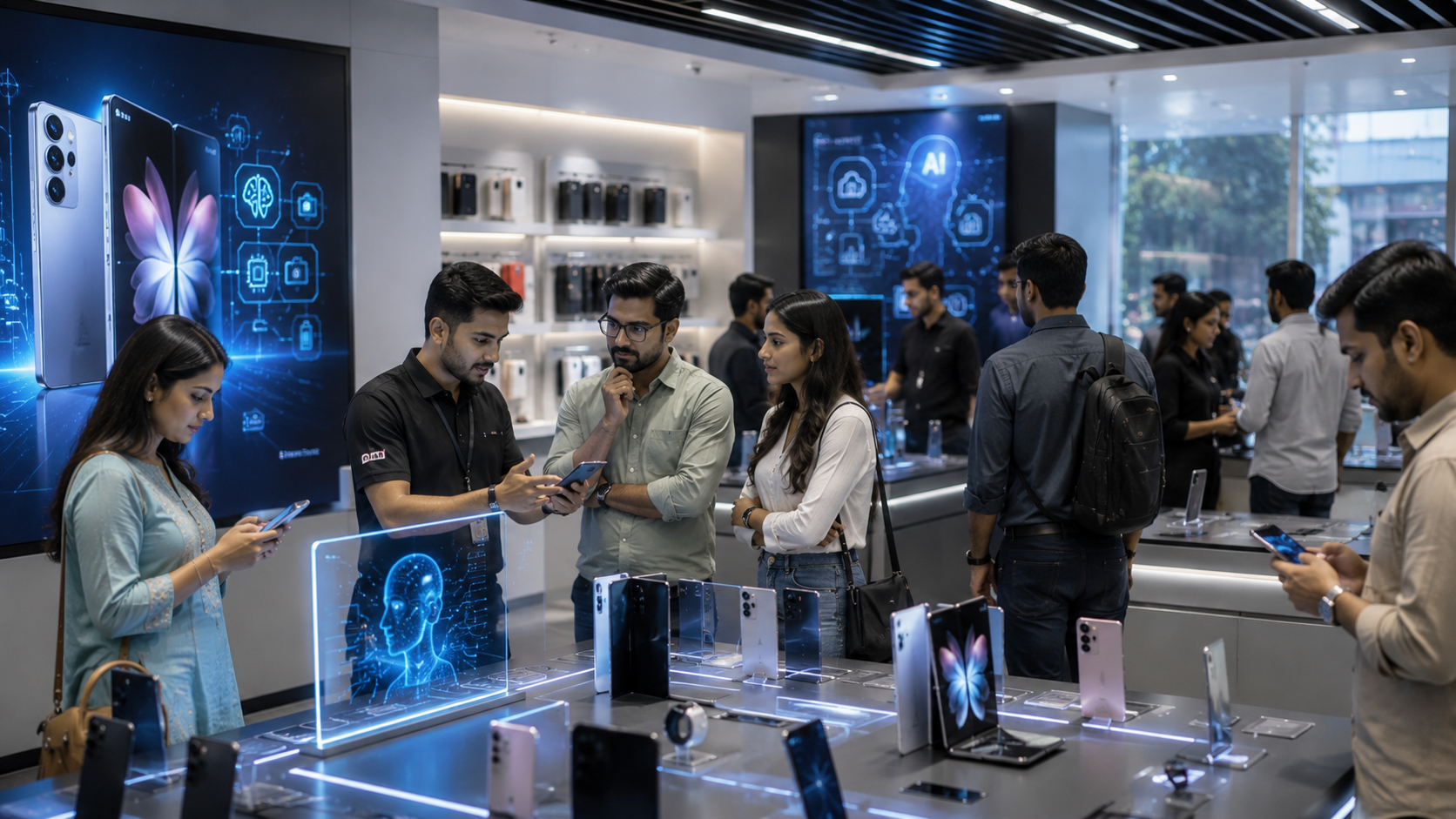
Fewer phones. Higher value. New rules.
Unlock Next by Redington | Mobility & Devices
The math has changed.
India shipped fewer smartphones in Q1 2026 than at any point in six years. Volumes dropped 3–5% year-on-year, yet the market’s value barely flinched. This single data point shows the story of where mobility is heading – it is about few values that focuses on higher value per unit. Here’s what data is indicating across volume, value, AI, form factors, financing, and the untapped upgrade pool.
The volume-value split is widening
Memory component prices surged 80–85% sequentially, pushing average retail prices up 15% across the board. Entry-level consumers are being priced out. Shipments at the bottom of the funnel are shrinking. Apple currently commands a record 28–29% value share in India. The premium pool is expanding even as total units decline.
IDC estimates full-year 2026 at 132 million units (down 13% YoY) but $42 billion in value. ASPs have risen 38% since 2020. The revenue concentration is shifting upward focusing on how mid-to-premium tier is where market value is holding and growing.
Offline experience is becoming the premium differentiator marking the importance of retail in positioning mobility as value share. A customer choosing to pay higher will primarily focus on touch and feel of the product – making consultative selling precede over specification comparison like RAM, ROM, Mega Pixels, Battery size and other functions. This shift has direct implications on how channel is built and supported. Redington’s D2R (Direct-to-Retail) model is designed precisely for this, connecting mobility brands to retail stores – enabling conversion of premium demands.
AI has become the purchase trigger
89% of Indian consumers now say AI features influence their purchase decision.
The hardware layer is catching up. Neural Processing Units deliver 30+ TOPS of on-device performance — real-time translation, professional editing, predictive productivity, without cloud reliance. Google Pixel grew shipments on AI-first positioning. Apple’s integration of generative AI across its ecosystem is setting a new baseline for what “premium experience” looks like. The sales conversation is moving from specifications to capabilities. From “how much RAM” to “what can this phone do that the last one couldn’t.”
Foldables are entering the mass adoption phase
2026–27 is projected the year of book style foldable phone going mainstream, accounting for 65% of all global foldable shipments. The entry of new players into this form factor is expected to reshape competitive dynamics and retail floor allocation. In the mid-premium tier, design-led brands are gaining share. Motorola grew volume by focusing on build quality and aesthetics that resonate with younger, style-conscious buyers. Form factor and design are re-emerging as purchase differentiators alongside performance.
Financing is reshaping who buys what
In the premium segment, nearly two out of three purchases are now financed. No-Cost EMI and Credit Line on UPI are reaching aspirational buyers in Tier 2 and Tier 3 cities who want flagship devices but don’t carry traditional credit cards. India’s BNPL market is forecast to reach $30.45 billion in 2026. The access to credit at the point of sale — in-store and online — is becoming a conversion factor as significant as price or brand.
The drawer economy: India’s hidden upgrade pool
70% of Indian consumers hold 2–3 unused phones at home. Industry analysts have started calling this the “drawer economy”, a pool of billions of dollars in dormant devices sitting in households across the country.
Apple already dominates the refurbished market with a 62.9% share, demonstrating that trade-ins have become a primary customer acquisition channel for the premium tier, not a secondary aftermarket. The consumer who trades in an old device, finances a flagship on EMI, and walks out with a new phone represents the most complete transaction cycle in mobility retail.
The bigger picture
The long-term trajectory points to value expansion despite volume headwinds. Smartphones became India’s top exported commodity in 2025 under the PLI scheme. The ecosystem is maturing and rewarding depth over breadth.
The market is consolidating around fewer units, higher ASPs, AI-driven purchase decisions, new form factors, and financing-enabled access. The shape of the mobility business in FY 2027 looks different from FY 2025. The demand is not weakening but moving towards more value-driven positioning.
Sources
Counterpoint Research — Q1 2026 shipment decline (3–5% YoY), Apple’s 28–29% value share, foldable forecasts (book-style at 65%)
Omdia— 1Q26 shipment data, brand performance (OPPO 21%, vivo, Samsung)
IDC — ASP rise of 38% (2020–2023), FY 2026 forecast: 132M units / $42B value
Flipkart-Counterpoint Smartphone Insights Report 2026 — 89% AI purchase influence, 57% pay premium for camera
Cashify User Behaviour Survey 2025 — 70% hold 2–3 unused phones, Apple 62.9% refurbished share
Business Wire / ResearchAndMarkets.com — India BNPL market at $30.45B (2026)
PIB — Smartphones as India’s #1 export commodity (2025, PLI scheme)